Design Is More Important Than Facilitation

Last month, Genevieve Smith posted some wonderful musings entitled, “What even is facilitation?” Her questions (and responses) are important, because they call out some misconceptions about what a good meeting actually entails, which can lead to… well, bad meetings.

I’ve long had this Zen image in my head of what a perfectly designed, perfectly facilitated meeting looks like:

I ring a bell to signify the start of the meeting, and at the end of the meeting, I ring it again to bring things to a close. In between, I don’t say a word. The participants feel each other’s presence and energy, mine included, and everything that needs to happen happens. There is this flow state carrying all of us along, generated by the participants themselves and the environment. We not only achieve everything we set out to do, but everyone feels heard and valued and alive.

I always have this picture in mind when I design a meeting, even if the gathering ends up looking very different. It’s less about how the meeting looks and more about how it feels to participate in it.

The closest I came to designing a meeting that actually resembled this image was in 2014. I was helping the Garfield Foundation build the field for practitioners interested in building and facilitating networks. As part of that, I got to design and facilitate a peer learning workshop for other facilitators and consultants. I wanted to create a space for my colleagues to learn from each other, but I also wanted to challenge our preconceptions about what a good meeting looked like and whether meetings were even necessary.

We held the workshop in a large, open experimental theater space in the basement of a downtown San Francisco building. At first, I was disappointed in the space’s lack of natural light, but I decided to lean into its intended purpose and use the metaphor of playwriting as the organizing principle for our meeting.

When people arrived, they greeted each other and mixed informally as usual. When the meeting started, I and my associates walked around the room and gave everyone an envelope with a letter inside without saying a word. I had written a “love letter” to each of the participants, explaining why I was happy they were there, and mentioning someone else in the room whom I wanted them to meet. In the letter, I asked people to find that other person and get to know them.

At first, people were surprised. Some chuckled at the unconventional opening, especially the ones who knew me. Several people, especially those were new to the group, told me later they were moved by the personal letter and that they felt welcome and more comfortable than they would have if they had to introduce themselves to the full group while sitting in a circle.

It didn’t stop there. When the moment felt right, I and my associates again walked around and handed new instructions to the participants. We asked pairs to form larger groups and to introduce their partners to others. We gave people “playbooks” — binders with templates where people could capture the story of the work they were doing — and we asked people to start filling them out for themselves and each other. Eventually, we had people capture themes and questions or just make art on a huge communal sheet of butcher paper.

That whole morning, I never said a word. I walked around the room, eavesdropping on conversations here and there, peeking at people’s playbooks, and enjoying the beautiful images that were beginning to engulf us. I often moved to the side and just listened to the group hum. I had worked out rough times for the exercises beforehand, but I didn’t look at my watch. I was clear about what I had hoped the group to achieve, and I made new moves when it felt right, but I mostly just let them work.

Finally, I rang a bell, got the group in a circle, and said, “Hello!” Everybody laughed. The rest of the meeting looked a little bit more “traditional” (at least for how I usually design), but when participants shared their reflections on the day, it was clear that I had made my points about meeting design and facilitation loud and clear.

Many years ago, my colleague, Todd Johnston, reminded me that the word, “facilitate,” has its roots in the Latin “facilis,” which means “to make things easier to do.” Remembering this etymology can shift our preconceptions about what good facilitation actually looks like. It’s rarely about having a charismatic person in the center of the room, entertaining the group with their wit and effortlessly guiding them through the agenda. Good facilitation actually starts well before the meeting.

We can’t make things easier for a group if it’s not clear what it’s trying to do in the first place. After goal clarity comes design, including whether or not a full-group meeting is even merited. If it is, then how we design it — the process, the physical environment, whom we invite and how, what happens before and after the meeting, etc. — can have significantly more impact than the skill of the faciltator during the meeting itself.

A surprising amount of physics and biology go into good design. A theater- or classroom-style room is not conducive to a participatory discussion. If you have participants sitting down all day or if you feed them a carb-heavy lunch (or nothing at all), then it’s going to be hard to keep everyone engaged and emotionally regulated. Motivated participants and skilled facilitators can fight and even overcome these obstacles, but why handicap yourself when it’s easier and more effective to address them before the meeting even happens?

Good design is more than just logistics. What questions will help unlock the group? How will you capture what the group discusses — insights, breakthroughs, decisions, etc.? What are the existing relationships in the room, and how do they impact trust and action?

A few years ago, I co-designed a large retreat that was facilitated almost entirely by junior staff at the organization. They did a far better job than I would have, not because they were more skilled, but because of the strong relationships they had with other staff members. Participants saw their own people facilitating, which made them more enthusiastic and invested in the conversations and which boosted the energy of the meeting as a whole.

In my Power and Love for Managers training, we spend a lot of time discussing how design helps foster the culture we’re trying to create. If you want your people to offer open and honest feedback, how is your design supporting this? Are you having regular one-on-ones with reports? Are you sending materials several days in advance so that people have a chance to study and think? Are you allocating plenty of space for discussion, or are you asking for feedback in the last five minutes of a crammed meeting?

Don’t get me wrong. Facilitation in the room — whether via an internal or external facilitator — is an important skill, one that I encourage folks to practice. However, good design plays a much larger role in the success of an engagement. If you really want to learn from great facilitators, pay attention to the time and care they invest in the meeting’s design, not just what they do in the room.

Celebrating a Meeting That I Had Nothing and Everything to Do With

Mindset Mania

I was in Detroit a few weeks ago for the RE-AMP Annual Meeting. I was there for reasons that were largely ancillary to the meeting itself. I’m not a member of the RE-AMP network. I wasn’t giving a talk. I didn’t participate in the design or facilitation, other than offering a thought or two when asked.

Still, my experience there felt like validation for everything I’ve been working on over the past two years. It was an incredible high, and it also demonstrated how much work still remains to achieve my larger goal of wide-scale collaborative literacy.

Success Breeds New Challenges

RE-AMP is a network of over 160 organizational members focused on climate change in the Midwest. Their shared goal is to reduce regional global warming emissions 80% by 2050.

It was co-initiated over a decade ago by my friend and former colleague, Rick Reed, who had a simple question he wanted to test:

What would happen if nonprofits and foundations alike took the time to sit down together to really, truly, deeply understand the system they were all trying to change?

So he tested it. With the backing of the Garfield Foundation, he brought together a small group of leaders in the Midwest working on climate change and convinced them to sit together, listen to each other, and strategize together.

The process took almost two years. It was messy and expensive, and it teetered on total and utter failure on multiple occasions. But it worked. Participants arrived at a shared epiphany about what the critical levers were for stopping climate change. The trust and relationships that were built and strengthened through the process led to quick and aligned action among nonprofits and foundations alike around those leverage points.

This strategic alignment resulted in many immediate wins, the most eye-opening being stopping 30 coal plants in the Midwest.

Success created new problems. The hard work of thinking and planning together had forged a collective attitude, a network mindset among the initial participants that drove the way they worked. Their success attracted new participants very quickly, but the shared understanding, the relationships, and the network mindset did not scale at the same pace.

Over the past few years, the network has made a number of moves to try to shift this. Most notably, they hired a network CEO and additional full-time “staff” members to be able to respond more quickly to the needs of the network. (RE-AMP is not its own legal entity. Its “staff” are all employed by other organizations distributed throughout the network.)

This investment in internal capacity has enabled the network to start addressing structural and bigger picture issues that had previously been left by the wayside. One of those issues has been re-integrating systems thinking and a more collaborative mindset back into the DNA of the network.

Helping Groups Help Themselves

Three years ago, I left the consulting firm I co-founded and a team that I loved in order to seek greater balance and impact. I felt that I was doing some of the best work in the field, but it was not translating into the larger-scale impact I was hoping for.

Ever since I got into this business in the early 2000s, I’ve always explained my vision of the world and theory of change with a simple thought exercise:

Think about the best collaborative experience you’ve ever had.

What would your life be like if all of your collaborative experiences were as good as that one?

What would the world be like if everyone’s collaborative experiences were all that good?

How about if everyone’s collaborative experiences were all just slightly better?

I believed (and still believe) that the world would be significantly better if we saw incremental improvement in people’s collaborative literacy across the board at scale.

However, that’s not where I focused my energy. I liked working on hugely complex problems that required cutting-edge capabilities. I did the work inclusively — the only way you had a chance to solve these kinds of problems — with the hope that people would learn enough through the experience that they could continue working in a similar way. Furthermore, I hoped that by openly sharing what I learned, I could have a broader impact than just the projects I was working on.

Both of these turned out to be true, but not appreciably so. The way I was working was benefiting me more than anyone else. It was an incredible opportunity for me to practice and learn and to do work that was joyful and meaningful, and it helped me establish a reputation that created more opportunities. Others were also learning from these experiences, but they weren’t as invested as I was, and there were few structural incentives for them to continue developing their skills after we finished the project.

If I wanted to stay true to my vision, I needed to focus on sustainable interventions for helping others develop their collaborative capabilities. I do not believe that the ability to collaborate effectively is some mystical talent with which only a select few are imbued. I believe that everyone has the ability to be much, much better. All people need are opportunities to practice.

For the past two years, I’ve been focused on creating those opportunities. I’ve been testing workouts and tools designed to help people develop stronger collaborative muscles and mindsets. I stopped doing work for groups and have focused instead on helping them develop the skills to help themselves. I’ve also been mentoring emerging practitioners who want to go the extra mile in developing their skills.

The Meeting

In some ways, RE-AMP has been an ideal testbed for my workouts and tools. Because it’s a decentralized network, it can’t change culture or practices by fiat (or by firing) the way an organization can. Practices have to work, otherwise they will be ignored, and they have to be adopted widely, otherwise they will be rendered ineffective.

Furthermore, its history of great work, strong relationships, and growing internal capacity served as a strong foundation. Its staff, along with many of the informal leaders in the network, are bold, talented, and hungry to learn.

I ran an early pilot of my Collaboration Muscles & Mindsets program with the RE-AMP staff last year. It went okay. Some things were well-received, some not so much. I developed an assessment to help me determine whether or not my program was working, but the main thing I learned was that my assessment needed improving.

Still, the program was effective enough that they were interested in making it available to the broader network. For the past few months, we’ve been discussing and planning a program that will launch early next month.

In the meantime, unbeknownst to me, the RE-AMP staff was cooking up something interesting on their own. They had decided to run a session at their Annual Meeting based on a Muscles & Mindsets exercise I had led them through at their staff meeting for a dozen people the previous year. They were going to adapt it for 160.

Scaling up the exercise would actually be relatively straightforward. Most exercises I design are meant to scale. Understanding this conceptually, though, and believing it enough to do it in a real-life, high-stakes situation takes courage, especially if you haven’t done it before. This is one reason why people hire people like me to do this for them.

But the RE-AMPers weren’t going to bother with that. They had the audacity to try it on their own. Prior to the meeting, they walked me through what they were going to do, and I made some suggestions and offered encouragement. Beyond that, I had nothing to do with the session.

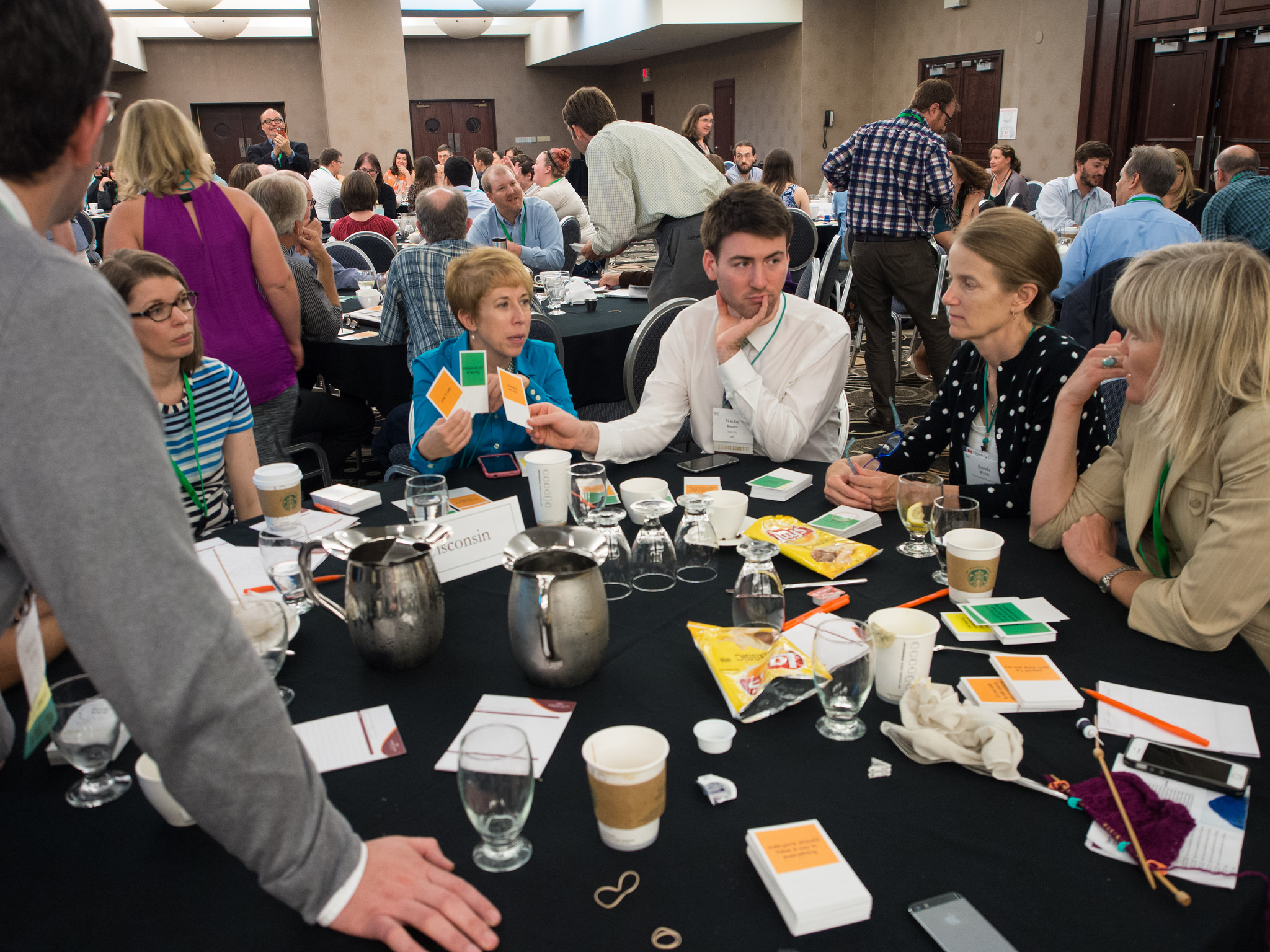
Watching the session was exciting on many levels. First, Sarah Shanahan and Trevor Drake expertly facilitated the exercise. They had a calm energy, and they gave clear instructions with compelling, relevant examples. They managed to command a large, rowdy room of people by giving up control, which the participants appreciated and which one person made a point of noting during the debrief.

Second, it was a thrill to watch 160 people using a toolkit — our mindset cards — that I had invested a few years and a ton of energy into codesigning. At my previous consulting firm, I had done a lot of organizational culture work with my friend and business partner, Kristin Cobble, who had introduced me to a framework for mapping mindsets to behaviors. It was effective, but also high overhead, and it required facilitators who were very literate with the framework. For example, it took us four months to do this work with a 75-person organization, and that was an accelerated process!

My motivation for designing the cards was to see if we could create a tool that would allow groups to condense a multi-month conversation into a few hours and to allow them to have that conversation without the aid of a framework expert. There were several examples of groups using the cards to great success with groups of 10-15, and I was confident that larger groups could benefit from them as well. But I hadn’t seen it… until the RE-AMP meeting.

It was amazing to watch 160 deeply engaged in conversation using the cards, and it felt even better knowing that they were able to do it without my help. I walked around the room, eavesdropping on conversation, peeking at people’s cards, and soaking in the buzz. I was in heaven.

Third, I was surprised by what happened. Gail Francis, who led the design of this session, had made a decision about something relatively minor against which I had advised. The final exercise for the 20 groups of eight was to use the cards to agree on a set of mindset “spectrums.” The question was how to capture these. I had suggested that the groups write them on a worksheet, then bring them to her. She decided to have people hold up their cards, which she would then collect and transcribe for them. It was a tradeoff between saving time for the participants and saving time for the facilitators.

She understood the trade-off and chose saving the participants’ time. That led to something completely unexpected — groups cheering in excitement every time they completed the exercise. It was fun, it was funny, it bolstered the already high energy in the room, and it likely wouldn’t have happened had she chose what I had suggested.

We’re Not There Yet

I’ve devoted the last two years to developing methods and tools that help groups help themselves. Seeing this work manifest itself this way at the RE-AMP Annual Meeting was gratifying and validating. Every group already has smart, capable people who have the potential to unleash the group’s intelligence. All they need is space, a little guidance, and room to practice and learn.

For this meeting, a few people got that space, and the results were outstanding. They were also only a fraction of what’s possible. As good as they were, they could have been much, much better. They’ll get there if the people in the network are given that room to practice their skills in bigger and more ambitious ways. Unfortunately, most groups do not give people that space.

All too often, “experimenting” consists of one-offs. Mastery doesn’t happen in a one-off. It takes time and commitment and lots of stumbling. In order to raise the bar and create the space for that growth, people need to experience what’s possible. Most people have such poor collaborative experiences, they either flinch and give up at the first sign of trouble, or they stop taking risks after they experience a small win. RE-AMP is ahead of most groups in this regard, but still, I wonder.

If my workouts and tools are going to have a chance at making an impact, then I need to find ways to make it safe for people to commit to them, and I also have to give people the experience of what’s possible. I’m currently exploring ways to do exactly that. In the meantime, I’m appreciating what I’ve accomplished so far and the people who have taken me there, and I’m excited about what’s coming next.

Thanks to Greg Gentschev and H. Jessica Kim for reviewing early drafts of this post.

Correction: The originally published version of this post stated that this was the first time the RE-AMP staff had decided to design and facilitate their Annual Meeting on their own without external facilitation. Gail Francis pointed out that this was not correct. While their early meetings had been designed and facilitated externally, they had actually been designing and facilitating their meetings on their own for several years. I removed my incorrect claim in this version.

Systems Change and the L-Word

"To love is to surpass." —Oscar Wilde

One of the signature tools that the Garfield Foundation advocates for in its collaborative networks projects is system mapping. System mapping is a way of visually capturing the things that influence a system and their relationships to each other. Doing this can lead to insights about high-leverage ways to shift the system, which in turn can help groups act more strategically.

That’s the theory, at least, and it’s one that’s widely espoused. But it’s also vastly oversimplified with some problematic assumptions.

The first assumption is that people can make sense of these maps in the first place. It doesn’t take long before a map becomes challenging to understand. One of the best maps I’ve seen is the one that emerged from the Hawaii Quality of Life project.

This map was constructed skillfully and thoughtfully and is easily browsable thanks to the wonderful tool, Kumu. But it still takes some time to wrap your head around it, and most system maps are significantly harder to understand than this one.

The second assumption is that the map represents a good model of reality. This depends on your definition of “good.” The quality of the map depends on its sources. How do you know if those sources are correct? Furthermore, in complex systems, nuances are critical, because small shifts can lead to big changes. How do you know if your model has captured the “right” nuances?

My friend and mentor, Jeff Conklin, likes to say, “All models are wrong. But that doesn’t mean they can’t be useful.” System mapping is a wonderful way of building shared understanding and trust. If I see my worldview represented in a system map, and if that map is used in my conversation with other stakeholders, I can see that others are truly listening to me and vice-versa. We can see our (sometimes surprising) common ground, and we can better understand our differences. That leads to higher-quality strategy and collaboration.

Reframing the mapping this way helps route around these problematic assumptions while also placing greater importance on how the maps get constructed and how they are used. If participants play an active role in constructing the map, they will better understand it and feel greater ownership over it. If they see it as a tool for understanding each other, they are less likely to be led astray by the false gods of rigor. If they understand the inherent limitations of the model, they are more likely to treat potential strategies as hypotheses to be explored rather than hard truths to be followed at all costs.

The third assumption is that people will be able to change their minds once they see and agree on a map of the system. This is the most challenging assumption of all, because it assumes that we are rational, which we are not.

Our system mapper, Joe Hsueh, recently wrote a wonderful post, “Why the human touch is key to unlocking systems change,” where he explained the critical importance of starting with self before looking at others.

Systems change with multi-stakeholder groups in a complex system is very hard. People get stuck in their respective positions and entrenched interests, refusing to be told they are the ones need to change. One simple phenomenon about change – we like to change others, but none of us like to be changed. Just think about the ones closest to us – our spouses, children, parents – how often are we truly successful in changing others?

In my year volunteering at a Buddhist monastery and charity organization, I learned I cannot change people. What I can do is to cultivate my curiosity to see a person for who she is and the compassion to love her as much as I can. Seeing a person for who she is the first act of love. When I am being seen for whom I am without judgment, it opens up a space for me to see myself authentically and give me the self awareness and choice to be my best Self.

Similarily, through our work on systems change at the Academy for Systemic Change, Presencing Institute and SecondMuse, we found the highest leverage is not out there but in here. “What is most systemic is most personal,” is a quote I love from Peter. How can we co-create a space for us to be human, to see each other for who we are as human beings, and to inspire one another to our best possible Selves? Only when we see each other and feel being seen can we begin to inquire the possibility of a shared vision that connects us as human.

You don’t find many system mappers citing the importance of the L-word — love — but love is at the heart of systems change, as our facilitator, Curtis Ogden, recently explained in a beautiful post.

Sometimes the L-word is explicitly acknowledged, sometimes it’s not, but it is always present in stories of deep systems change. In the late 1990s, the groundbreaking Public Conversations Project quietly began convening a dialogue between leaders of both sides of the abortion debate. They spent six years in deep conversation and were not able to find common ground on the issues. What they did find was that they loved each other more. They wrote:

In these and all of our discussions of differences, we strained to reach those on the other side who could not accept – or at times comprehend – our beliefs. We challenged each other to dig deeply, defining exactly what we believe, why we believe it, and what we still do not understand.

These conversations revealed a deep divide. We saw that our differences on abortion reflect two world views that are irreconcilable.

If this is true, then why do we continue to meet?

First, because when we face our opponent, we see her dignity and goodness. Embracing this apparent contradiction stretches us spiritually. We’ve experienced something radical and life-altering that we describe in nonpolitical terms: ”the mystery of love,” ”holy ground,” or simply, ”mysterious.”

We continue because we are stretched intellectually, as well. This has been a rare opportunity to engage in sustained, candid conversations about serious moral disagreements. It has made our thinking sharper and our language more precise.

We hope, too, that we have become wiser and more effective leaders. We are more knowledgeable about our political opponents. We have learned to avoid being overreactive and disparaging to the other side and to focus instead on affirming our respective causes.

Since that first fear-filled meeting, we have experienced a paradox. While learning to treat each other with dignity and respect, we all have become firmer in our views about abortion.

We hope this account of our experience will encourage people everywhere to consider engaging in dialogues about abortion and other protracted disputes. In this world of polarizing conflicts, we have glimpsed a new possibility: a way in which people can disagree frankly and passionately, become clearer in heart and mind about their activism, and, at the same time, contribute to a more civil and compassionate society.

I believe strongly in the value of good, reality-informed strategic thinking. I have no doubts that a mapping process would have improved the Public Conversations Project discourse. However, I also don’t think it would have changed the final outcome. What mattered most there was that people were engaging with each other deeply and authentically. They were learning to appreciate each other’s humanity.

Any effective systems change process — whether or not you are using mapping to support it — is ultimately about helping us understand and love each other. What role is the L-word playing in your systems change process?

The Secret to High-Performance Collaboration: Slowing Down

Run, Serena, Run!

At my previous consultancy, we used to spend a considerable amount of time debriefing every engagement, big or small. We were meticulous in our analysis, nitpicking every detail.

Over time, I started noticing a few patterns. First, I realized that our debriefs were largely ineffective, because we weren’t taking the time to integrate what we learned. We needed to be reviewing past debriefs before new engagements in order to remind ourselves of what we had learned and in order to hold ourselves accountable to improvement. Without that additional space, our debriefs were essentially exercises in self-criticism and generating lists, two skills we didn’t need to be practicing.

Second, a few things began to jump out at me as I reviewed our long list of things we could have done better. Almost without fail, when we had “bad” engagements, someone had slept poorly the night before. Or someone had been working while sick. Or someone had forgotten to eat breakfast that morning. (Forgetting to eat was my personal bane.)

We had spent hours and hours and hours debriefing, and this is what we learned:

  • When we didn’t take care of ourselves, our performance suffered.
  • When we didn’t take time to remind ourselves of past lessons, we repeated the same mistakes.

One of my mentors, Gail Taylor, is always encouraging me to seek the simplicity embedded in complexity. What I’ve realized over the years is that, when I find it, I often dismiss it. It seems too obvious. There has to be something else.

Slowly, but surely, I’m breaking this habit, and I’m starting to see more clearly as a result. Which brings me to my biggest insight over the past several months.

The best thing we can do to improve collaborative effectiveness is to slow down.

This has been coming up for me over and over again with all of my recent projects and experiments.

I’m currently doing an experiment with the Code for America incubator in trying to help new companies establish good collaborative habits right from the start. PostCode (the company with which I’m working) is working at a startup pace, and they’ve had inevitable challenges as they move through their storming phase.

Fortunately, when problems crop up, they deal with them quickly. In those situations, they’ve often reached out to me about possible toolkits to help them navigate their challenges. My answer has been consistent: Slow down. They haven’t found the time (beyond the work we’ve done with them, which has been too constrained) for critical conversations about organizational strategy, culture, and group dynamics. It’s understandable. They’re under a tremendous amount of pressure, and in those situations, conversations about strategy and group dynamics can feel like a nice-to-have, not a need-to-have.

Last week, I facilitated a practitioners workshop for the Garfield Foundation on collaborative networks. For one of the Open Space sessions, I led a group through the power workout I developed for Changemaker Bootcamp. We had a wonderful, nuanced conversation about power dynamics, and several people asked, “How do we make sure we have more of these conversations with our constituencies?” My response: “The first step is making the time.”

Telling others (or even yourself) to slow down is easy. Actually doing it is hard. We move fast because of external pressures, mindsets, habits, cultural norms, and so forth. We have little control over most of these things, and what little we can control is incredibly hard to change. But there are tricks that I’ve found helpful over the years.

Experiments. Changing habits is hard, and you will likely fail many times. Approaching the challenge of slowing down as a series of experiments helps. As I wrote previously, one of the keys to a successful experiment is to hold yourself accountable to the results. Failure is okay as long as you’re committed to the intention and are actively incorporating what you learn into new experiments.

If you are truly committed to slowing down, write it down. Write, “Slow down,” on a piece of paper, and put it up where you will see it. Actively devise and track experiments that will help you do this, so that you can monitor your progress and see what’s working and what’s not.

For important conversations — whether it be organizational strategy or a project debrief — schedule those in advance as part of your project plan, and track whether or not they actually happen. If they don’t happen, take the time to examine why, and devise another experiment. The beauty of applying an experimental framework is that simply the process of devising and tracking an experiment is an act of slowing down.

Checkins. My former business partner, Kristin Cobble, recently wrote a wonderful piece on the power of checkins. She describes them mostly in the context of meetings as a way to invite participation and to garner a sense of the collective whole. What I’ve learned over the past several months is that they also serve a much simpler, deeper function. They force you to slow down and reflect — even if just for a moment.

Starting last year, I embarked on a simple experiment with my friend, Seb Paquet, who’s based in Montreal and who, like me, works for himself. We decided to check in with each other once a week for an hour over Skype. We didn’t have any agenda. We would simply use that time to have an extended checkin.

We ended up doing two phases, and it served to be tremendously valuable. Not only did it deepen our relationship, it served several practical purposes. We both had an opportunity to give each other feedback on our respective projects. We supported each other when we faced challenges and cheered each other when we succeeded. The most interesting thing to happen was that, even when things got tremendously busy for both of us, we both stayed very committed to these checkins. They were not just nice-to-have; they were helping us work more effectively.

Inspired by these results, I invited my colleagues Pete Forsyth, Rebecca Petzel, Odin Zackman, and Amy Wu — who all work independently — to participate in a similar experiment earlier this year. We wanted to experiment with ways that we — as an informal network — could achieve the same (or better) benefits that people get from working in great organizations. In particular, we wanted to be more intentional about learning from each other. We called our experiment, Colearning 2.0, a play on the coworking movement.

We explored several things that we could do together, but we settled on doing weekly pair checkins, as Seb and I had done beforehand. There was some reluctance at first. One thing we all had in common was a frequent feeling of overwhelm, and taking an hour out of our week to “just talk” seemed burdensome. Not only did everyone end up finding the experience valuable, there’s a desire to continue the practice and take it to the next level.

I recently spoke with Joe Hsueh about his recent trip to Istanbul. One of the things that struck him the most about his trip was the adhan — the Islamic call to prayer. Imagine being in a bustling city of 14 million people where every day, at prescribed times, a horn sounds and the entire city goes silent. Imagine what it feels like to have that regular moment of collective, silent reflection.

I believe that checkins could be a powerful keystone habit that helps us slow down overall, which ultimately helps us collaborate more effectively. This is a hypothesis I continue to explore.

What helps you to slow down? What’s been the impact of doing so?

Navigating Complexity Through Collective Sensemaking

A core strategy for navigating wickedly complex problems is to try to make collective sense of the system. Like the blind men and the elephant, we all have a narrow and incomplete view of the system in which we’re operating. If we could somehow see and fit each other’s pictures together, new and powerful insights and actions could emerge.

That’s the theory, at least. But how do you do this in practice? What does the process feel like? And how do you reconcile this approach with my earlier assertion that collective intelligence is not about enabling individuals to grasp the whole system?

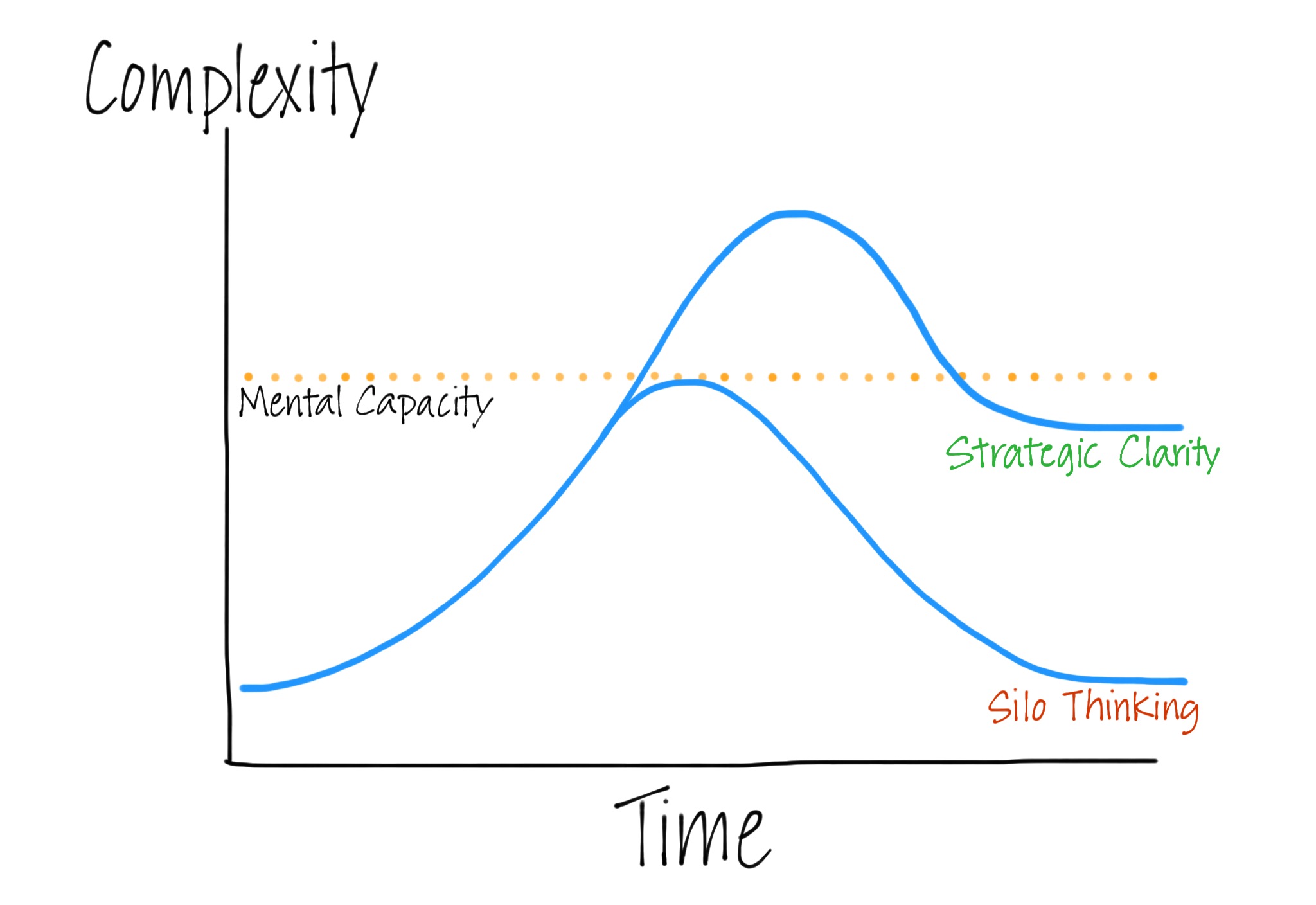
At last week’s Garfield Foundation Collaborative Networks initiative kickoff, Joe Hsueh walked us through his answer by drawing this graph. (Joe himself explains the graph in the above two-minute video.)

Navigating Complexity Model

We as individuals try our hardest to navigate complexity until we hit our mental capacity. Generally, that experience is so exhausting and dissatisfying, we find ourselves dropping back into simplistic, siloed thinking.

The goal of a collective sensemaking process is to help individuals endure greater complexity than we normally can handle. At some point, we still have to simplify the system in order to process it as individuals, but the hope is that, by raising the overall bar, you end up at a higher place than you were before.

With system mapping (which is the tool that Joe so skillfully employs), the map itself is of limited utility to individuals who have not participated in its creation, because they have not gone through that process of mental endurance. This is a critical point. The real value of system mapping isn’t the final artifact. It’s the process of developing shared understanding by collectively creating that map.

An Aside on Facilitation

You can’t design or facilitate these kinds of processes effectively unless you yourself have a strong framework around complexity and systems thinking. Good designers create the space for participants to live in this complexity.

Living in complexity is inherently disorienting, and people have different appetites for it. Part of the facilitator’s job is to help the group maintain their faith in the face of intense discomfort. One way you can do that is by walking the group through your framework.

Unfortunately, I often see facilitators make the mistake of spending too much time explaining frameworks up-front rather than giving the participants the space and time to experience the framework. It’s a tricky balance, and finding that balance is a sign of mastery.

At last week’s meeting, Joe offered the framework at exactly the right time. You could see the relief on the participants’ faces as he explained that the joint struggle and frustration that everybody was experiencing was all part of the process.

It reminded me of a similar moment with one of my mentors, Jeff Conklin, during the Delta Dialogues in 2012. The participants were getting frustrated by how much the conversation was jumping around (which was by design), and I felt like we were starting to lose them.

Jeff stepped in, and drew and explained a graph that described the different ways that people learn. It was beautiful to watch people’s faces light up with understanding. Jeff’s impromptu (and brief) lesson in theory not only helped orient our participants, it gave them language to describe what they were going through.

What Practice Looks Like

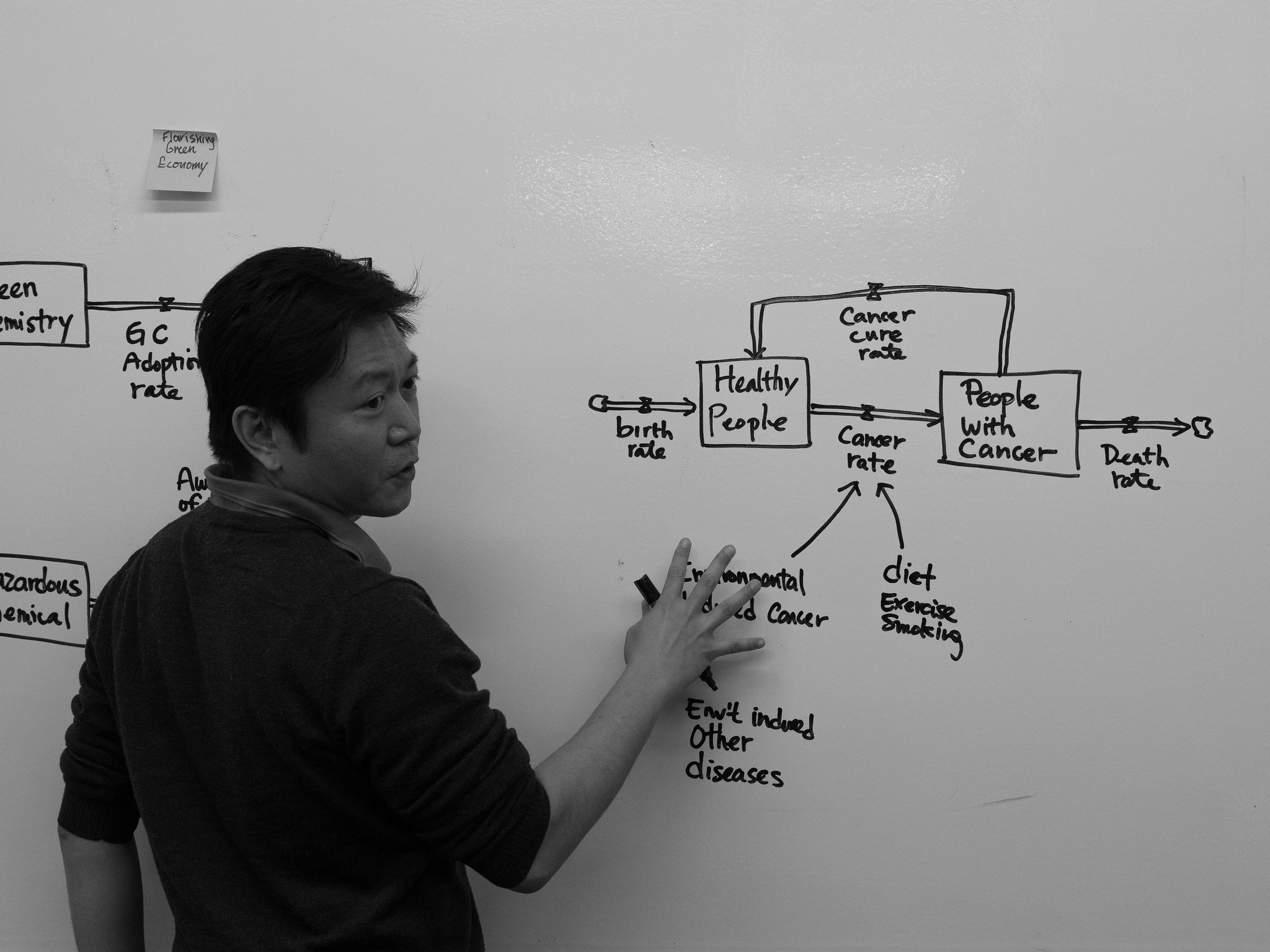
Joe Hsueh Mapping

I’m facilitating the kickoff of the Garfield Foundation Collaborative Networks initiative later this week. In one of the modules, I’ll be asking people to share their theories of change for the challenge we’re all tackling. You can imagine an exercise like this with a room full of veteran changemakers going for hours and hours, but we’re limiting it to 90 minutes.

The primary goal of the exercise is relational. It’s for people in the room to start developing a more explicit shared understanding of each other’s worldviews and to practice deep listening. We’ll devote an extensive amount of time after this meeting to expanding and dive deeper into this conversation. For now, we want to capture a quick picture of the collective understanding in the room.

To do that, I’m co-facilitating the exercise with Joe Hsueh, a skilled system mapper. Joe will be facilitating an extensive system mapping process after the meeting, so it made sense to use the same technique here not just as a capture method, but as a way to familiarize the group with the process.

Joe is a veteran. He’s been doing this for years, and he’s highly sought after. He not only has deep experience with mapping, he has a facilitation philosophy that is unusual for system mappers and that is strongly aligned with ours.

I’m no spring chicken either. I know what I’m doing in a room full of people. I also have a lot of experience dancing with mappers of all kinds, from dialogue mapping to graphic recording.

Joe and I have never facilitated together before, nor have we even seen each other facilitate, but we have a trust and respect for each other that would have allowed us to do this successfully cold. We spent an extensive amount of time talking through the process and exploring scenarios. Our preparation was more than adequate for us to do what amounted to a relatively straightforward exercise.

We decided not to settle for that. Joe braved some awful weather a few weeks ago to fly from Boston to San Francisco so that we could practice. We had spent plenty of time talking about the process. This was time for us to get up in front of the room, Post-Its in hand, and practice. Rick Reed and Ruth Rominger played the role of participants, then critiqued us as we reviewed our work together.

Even a little bit of practice surfaced flaws in our assumptions and different understandings of what we were doing. Most people wouldn’t have seen what we saw, but to us, it was the equivalent of stepping on each other’s toes on the dance floor.

And so we practiced and discussed and practiced some more. We discussed which color Post-Its to use in different situations and why, as well as our physical positions in the room. We figured out which exercises we could shorten and which ones required more time.

When we get together later this week to facilitate this exercise for real, everything will be different. Someone will say or do something that will once again force us to adapt on the fly. We’ll do just that, and we’ll do it skillfully. Improvisation is a huge part of doing this work well. However, as everyone who does any form of improvisation knows, you get better at improvisation — and dancing — by practicing.

In this field, most practitioners do not invest time for practice. Our mindset is that we can do a good enough job by relying purely on our experience. This is true. But ours seems to be the only field that talks about wanting to be high-performance, and yet settles for good enough. If we want to create a better future for ourselves, we have to stop settling. Practice is what will take us to the next level.

A certain level of humility is also required to embrace practice. I was particularly impressed by Joe’s learning mindset. I know a lot of practitioners who would stiffen at the thought of doing an “additional” walkthrough like we did, who would view that as an affront to their experience. I know a lot of practitioners — myself included — who don’t like “looking bad” in front of their peers. Practicing with others exposes your vulnerabilities. However, those vulnerabilities are the very reason you should be practicing in the first place. Joe didn’t seem to have those hangups. He was comfortable with how good he already was, but he wanted to get better.

In When We Were Kings, the documentary about Muhammad Ali’s legendary “Rumble in the Jungle” with George Foreman, several people noted that Ali focused almost entirely on his weaknesses during practice, and generally looked bad and vulnerable. We all know what that translated to in the ring. We as practitioners of a different sort could learn a lot from that example.